- THE BLONDE ROAST
- Posts
- Cinematic Fashion & Obsession
Cinematic Fashion & Obsession
The June 2025 Issue of 'In Pink Print' by Gillian Jane Johanns


The Blonde Roast & Gillian Jane Johanns
June 23, 2025
In January last year, when the photos and videos began pouring in from John Galliano’s Spring 2024 Margiela show, my jaw naturally dropped, I propped up in my bed, and began down the hauntingly stunning spiral of the show’s entirety; the opening short film, the live vocals, the eerie setting under a Paris bridge, and the oscar winning models limping down the alley. This is what people must have felt like in the performance era of fashion shows in the 90s, I thought. But there I am in my Toronto bedroom before a serving shift, having this thrill of obsession and running imagination because of this runway show. I want to write, I want to go shopping, I want to cut up some magazines or something, I’m antsy and elated because of this literal magic show.
There’s these moments in fashion that I love, and then there are moments in fashion that I love so deeply I get that stomach-pit-ache about not being able to be more involved with it all. A really good movie or book series can do this for me too, I’ve had works of art do it for me, I’ve had songs and albums do it. I think this is a familiar feeling most people get across all forms of media, but what a specific art it is, to do it in moments of fashion. And one that is not as easily fulfilled with hours of saved TikTok edits. Why am I looking at fabric on someone, and instinctively imagining entire backstories of where it came from?
When I look for what I want to read, write, or watch, I’m always searching for something highly descriptive, with vibey worlds and settings. I love a hauntingly stunning and old institution like in Donna Tartt’s The Secret History, or the colourful atmosphere of Coppola’s Marie Antoinette. But in terms of fashion–maybe it’s because a lot of times the entrancing energy it provides comes first, and those subjects happen to be wearing fashion that I can obsess over, second. Like, I’ve been reading Patricia Highsmith, and she includes clothing in her writing in a very subtle but clear way that really situates her characters with purpose but is in no way a book about fashion. But a fashion-lover reads it and can imagine the vintage Gucci bags and iconic green ring so clearly. Then we get the movie adaptation, and I’m loving the story, but the main character on my mind is the clothing department, and now I get to obsess over this movie from a fashion perspective.
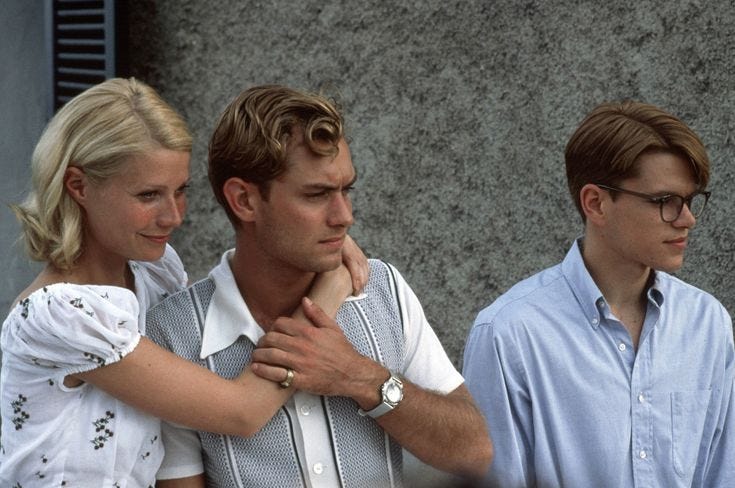
I think these fashion-obsession moments happen when the artist or director creates something that looks or seems completely vast, but chooses to zoom-in on a subject intentionally. “To see a world in a grain of sand” type of thing? I think this a pretty agreeable, widely understood point. But I think when I’m looking at fashion and get this feeling, it’s the purposeful pinpoint of a subject that looks to be part of something bigger that I find most alluring. And I think it’s something that people “outside of fashion” don’t see in fashion a lot of the time.
Cinematic Fashion
Jacquemus is the king of these cinematic campaigns. He has this direction in his work that comes across, just as I described, as a specific shot of something much bigger that we can’t see, but want to figure out. The subjects have a quirky way about them or the backdrop is wildly idyllic. There’s an art to crafting campaigns that you’d want to live in. A recent campaign of his that sparked this thought of mine was a shoot done in Egypt for his 2025 Spring campaign titled, La Croisière meaning “The Cruise.” (There’s a French movie with this same title, I’m not sure they’re related, but maybe a layer to my case here). The campaign, which is more about the photography than the clothes, is set on sailboats and waterfronts with this painted backdrop of the sky, sand, and water. Things we’ve all seen before, but these ones look more lavish and perfect than anything I come across day to day. His trick here is that the camera work is the star, and that then promotes the clothes.

Jacquemus has been credited many, many times online as being a Marketing Genius for his very immersive, very fun, and always very French media tactics. But for me, his campaigns still come across with an obscurity and naturalness that other popular brands might fail at. Popularity might drive initial success but so often, even if wildly admired for a second, a lot of trendy brands will lack anything with emotional tangibility and thus longevity. The difference is that Jacquemus’ work doesn’t come across as being campaigns that are made to become popular, but instead, are campaigns that are popular because they work. Jacquemus might have buzzy moments, for sure, but his art-over-trend-driven-approach keeps him hot on the back burner while the Rhodes and Labubus of the industry are up front and burning out.
And what works for me is when I come across fashion that makes me want more. When fashion is used as a visual narrative power, the sheer ability for that campaign to become something beyond just fashion goes from nothing to everything. I think a lot about that Margiela show. Like jeeeeez, what I would do for that show to become a movie or a book adaptation. The collective hypnotism of that show was talked and talked and talked about. It’s these moments of “perceived immersiveness” that I think make fashion its most pronounced.
I have this theory about Jacquemus: I look at Jonathon Anderson’s costume work for Queer and Challengers, and I credit at least 75% of those movie’s cultural success completely to his work - and my theory is that I think if Jacquemus were to put himself in this same position in film, it could be that next big talked-about movie.
Anderson, especially for Loewe, is a designer whom I consistently enjoy, campaigns and all. He took his clearly established creative direction and created such defining moments in the universe of Challengers, from the ‘I Told Ya’ shirt to Zendaya’s press tour looks. It was like my desire for getting more out of fashion-obsession with Anderson was satisfied into entire movies. Likewise, Jacquemus’ clothes were used in the recent season of The White Lotus, and whether you knew it was him or not, the character of Chloe wearing fresh-off-the-runway pink Jacquemus situated her character perfectly. As a knower-of-fashion, we saw that look and could instantly place her as being someone deeply integrated in luxury and someone on a higher ‘level’ than the average viewer. And as a non-fashion-knower, you look at her in this pink dress and see the pure quality and energy that this look emanates on her. This specific look, we saw for only minutes, was such a standout of the season; imagine what Jacquemus could do with hour-long formats instead of minutes.
So, when and if you see Jacquemus spearheading the wardrobe of the next major Summer movie, please tell them I sent him.

An Edit of Sorts…
And so…so what? This is a continuation of my thoughts on intentional fashion and the importance of integrating meaningful art into all forms of art. But with no advice on the matter and purely just ideas and theories to sit with, let me tell you what I’ve been reading, listening to, and watching this month that could all potentially be an element of inspiration that led to this month’s piece, who’s to say!
Reading:
Eve’s Hollywood by Eve Babitz
The Talented Mr Ripley by Patricia Highsmith
In Vogue: Summer Nights in the City: An Ode, With Fashion Made to Move In By Sophie Kemp
Women in Clothes by Heidi Julavits, Leanne Shapton, and Sheila Heti
A lot of social and feminist discourse on Sabrina’s Manchild cover…
Listening:
The Chiffon Trenches by Andre Leon Talley (Audio book)
Something Beautiful by Miley Cyrus
Sign O’ The Times by Prince
Amy Winehouse at the BBC
Live by Erykah Badu
Watching:
The Talented Mr Ripley (the movie!)
Something Beautiful by Miley Cyrus (the movie!)
– Gill
Reply